
Proactively Fighting the Devastation of Hemlock Woolly Adelgid
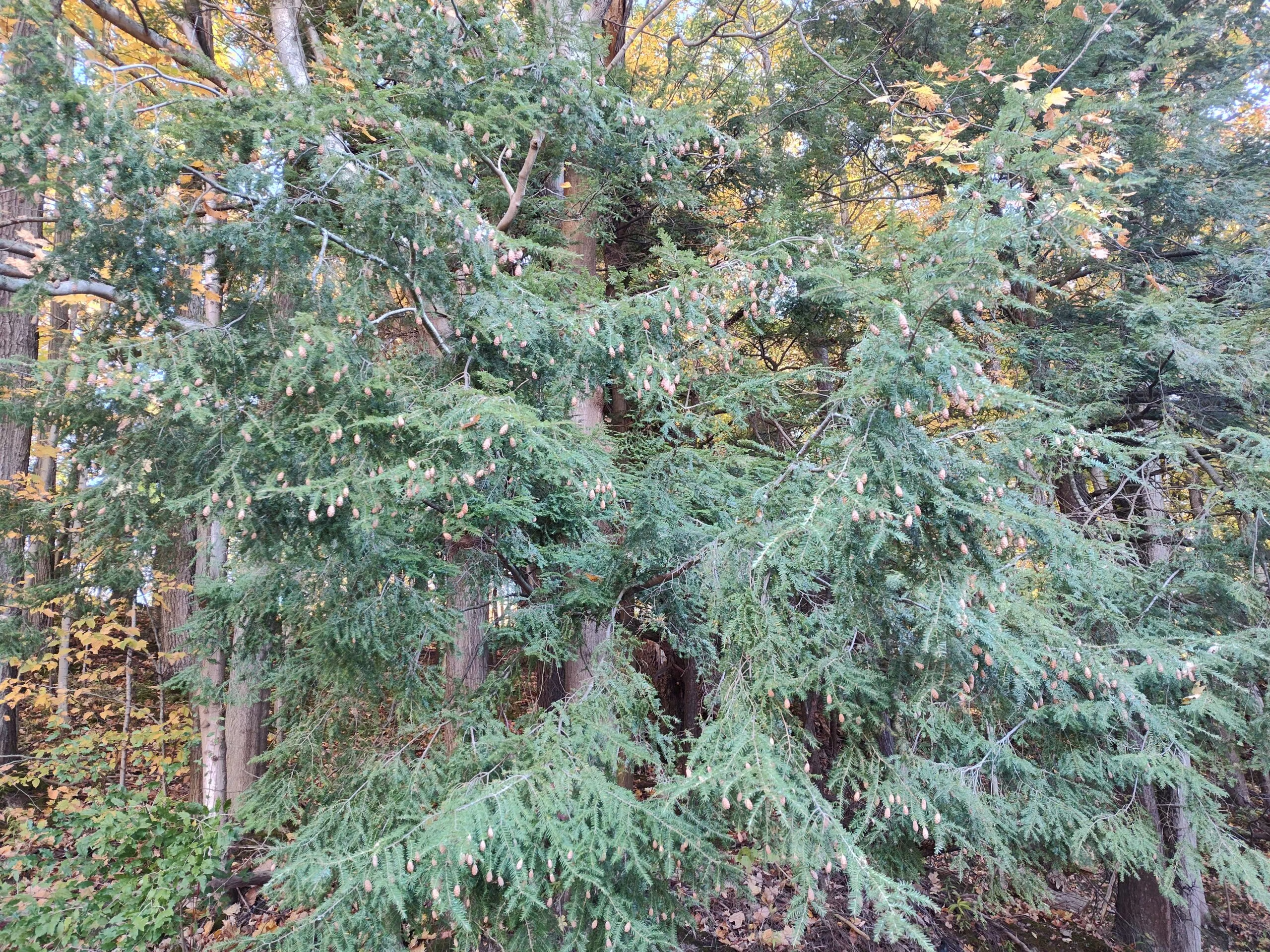
The St Williams Conservation Reserve (SWCR) hosts a remarkable collection of trees called the Picetum in an area south of Front Road in Turkey Point, Norfolk County, Ontario. Created in the 1960’s for research purposes, the area once had 23 species of spruce as well as other types of conifers. Although some species have died out, there remain many unusual and rare trees. And, nestled in this area, is a significant population of native eastern hemlocks. Hemlocks are a foundation species, offering food, shelter, carbon sequestration (a hot topic in the world right now as we deal with climate change), cooling shade as they grow into the overstory, and since they like to grow near streams, their presence even helps keep the waters cool. Joelle Giles, Coordinator for the St Williams Conservation Reserve Community Council, says, “While there are 6 hectares of nearly pure hemlock stands, when the scattered trees towards the edges of the stand are counted, it makes up approximately 11 hectares of hemlock habitat. The feeling you get when you’re walking under those gentle giants is important to note.
The way that their branches hang down and sweep horizontally reminds me of bunting decorations – they have such a calming, cooling effect AND it’s something worth celebrating! Walking through the undulating trails, surrounded by steep ravines and ridges, seeing the cold-water stream meandering through the rugged landscape – it’s a therapy all on its own. I can see why the Louisiana Waterthrush chose to call this area home.” As hemlocks mature, they spend many years in the understory of the forest. If mature hemlocks die, this opens the forest overstory (or canopy) up and has a negative impact on the younger trees. Too much sunlight is not conducive to healthy growth as they require moist soil and protection from high winds for their shallow roots. A mature forest overstory provides this. Currently North America is facing a catastrophic invasion of a non-native insect, the hemlock woolly adelgid (Adelges tsugae). Pronounced a-DEL-jid, the natural host for this relative of the aphid is the tiger-tail spruce (Picea torano) which is not found in North America. The secondary host is the Asian hemlock, also not found here.
The next best thing is eastern hemlock (Tsuga canadensis) and Carolina hemlock (Tsuga caroliniana). Native to Asia, (HWA) Hemlock Woolly Adelgid has moved across North America and has been spreading from Tennessee through Maine and Ontario, east to Nova Scotia. It has also been found in Michigan. In its native habitat it causes little harm but in non-native areas such as North America, its damage is widespread and devastating. Our native hemlocks have no resistance to this introduced pest. Although HWA has not been confirmed within the SWCR boundaries, it is difficult to spot and has been found close by, in areas in Norfolk County as well as Haldimand County. Without natural predators, HWA presence continues to spread. And it targets hemlock trees. Here at the St Williams Conservation Reserve in the Carolinian Forest Zone of Ontario, the Adelgid could potentially harm or kill many of the naturally occurring hemlocks found here.
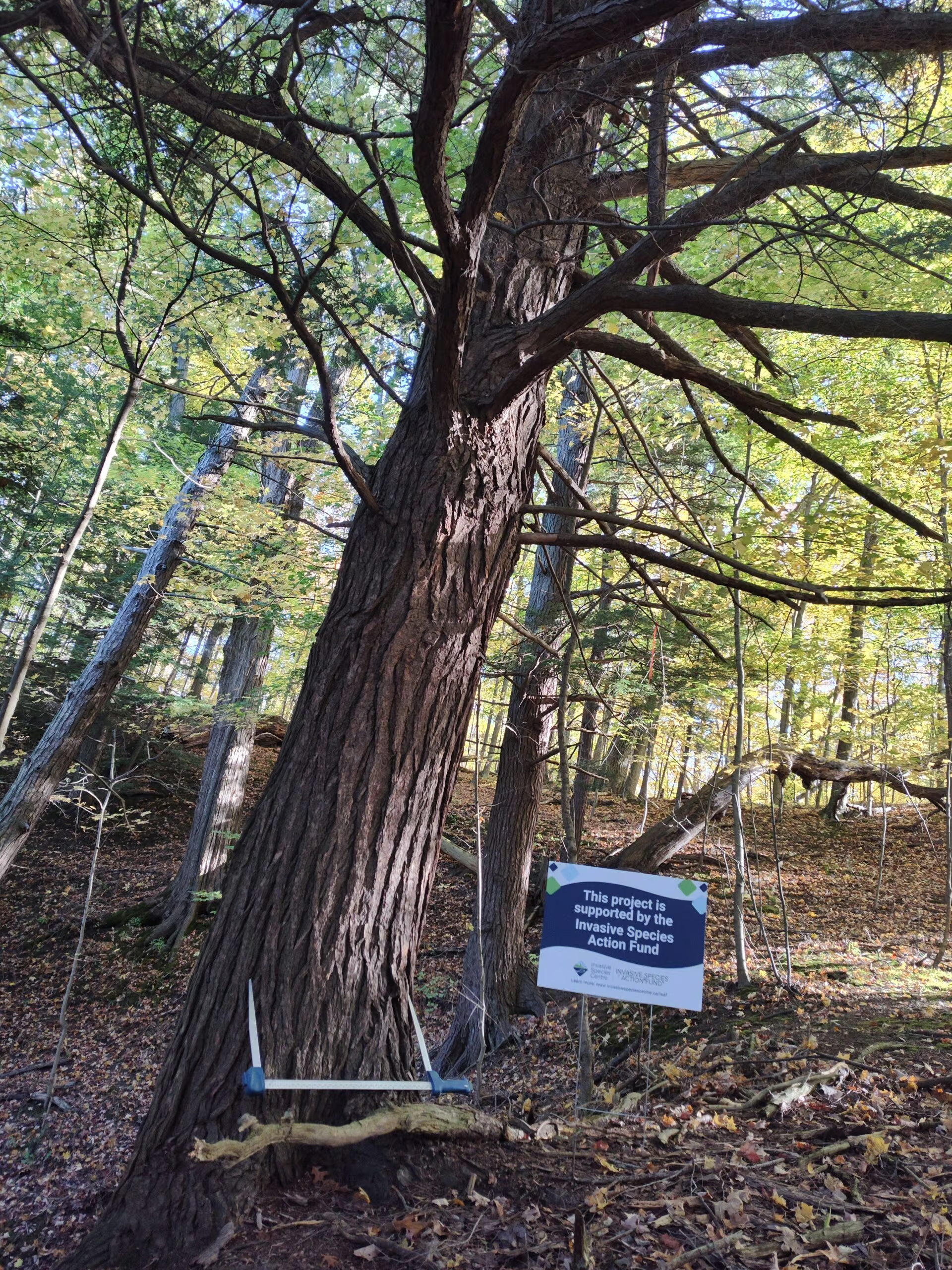
The natural diversity in this area is extensive and habitats would be negatively impacted should the Adelgid kill off the hemlocks, some of which are hundreds of years old. As noted previously, the HWA has not been found within the boundaries of the SWCR, but it has been identified in nearby hemlock stands, so proactive action must be taken now. Joelle told us, “This is a carefully planned conservation effort intended to preserve the ecological function of this area. We don’t expect to save every hemlock (much in the same way that we realize that this treatment likely won’t only harm HWA – other insects feeding on the leaves will be affected!). We’re trying to retain as much of this landform as possible. Losing these hemlocks wouldn’t just change the appearance of the forest, but the temperature, moisture, light, and plant & animal communities would also change… so much depends on these hemlocks!” The life cycle of adelgids is complex.
Their size makes it difficult to spot at only 1 to 2 millimetres. Think of the size of a pin head. That is the size of an adult HWA. And 15 to 25 of their eggs could fit on that pin head. Tracking is difficult because they are so tiny. The HWA can complete a life cycle asexually in only a year or sexually in a two-year cycle. In North America, since their primary host is not available, they reproduce asexually and produce 2 generations per year. When newly hatched the nymphs (reddish-brown to black and only 0.4mm in size) are called crawlers and this is often the only mobile life stage. Once they settle on their host and begin to feed, they exude a white, waxy material that covers their bodies. It resembles cotton wool, hence their name. The material is flocculent, which is another reference to the resemblance to wool. The asexual life cycle is completed twice a year. The first-generation hatches from eggs in June and settle onto their feeding site until fall.
They are called sistens at this stage. In the fall they resume development and reach adult stage in mid to late winter. Females are darker larger than males and can be up to 1.4 mm long. These females lay eggs in April and May. For this generation, they do not go into dormancy until fall but rather become adults themselves with the ability to lay eggs as early as June. These adults are smaller than their parents. But this ability to have 2 generations within a single year poses more problems as they are attacking a higher number of trees simply due to their own numbers. Nymphs eat by inserting sharp stylets (mouth pieces) into the tree’s tissues, injecting their saliva, and then sucking up nourishment. They prefer to do this with new shoots. The damage done to the primary host produces galls while secondary hosts fare much worse, with loss of needles, twigs and stems near the feeding sites. In all cases, the tree no longer functions in a healthy manner.
The saliva injected into the feeding sites restricts nutrient flow in the affected tree, preventing new growth. These pests are tiny and hard to spot but the damage they do to trees is very evident. Desiccation, discolouration and loss of leaves (needles) is common. Shoots near to the feeding site are deformed. Thought to have initially been introduced to North America in Virginia in the 1920’s, its steady spread is causing concern on a large scale, as it is decimating hemlock forests. Treatment is difficult for a number of reasons. Hemlocks prefer sites that are adjacent to waterways; many chemicals cannot be used in these locations. At this time, there is no permanent treatment. All the current options are not a perfect solution, but the hope is that while we keep these trees healthy, some permanent solution WILL be found. Science continually surprises us with the advancements it makes and biologics being tried out west are looking very positive. The first step was to identify trees that had the best chance of survival, that were strong specimens in accessible locations and would have the greatest impact on the surrounding area if it died. Joelle Giles explained the entire process, start to finish, for us here.
“The treatment itself is very involved and takes a lot of planning and thoughtful care. The first step is identifying the extent of the hemlock population. Each one of those trees needs to be documented before treatment starts. A crew of two went out, and systematically noted the GPS location of each hemlock, recorded its Diameter Breast Height (DBH), and assessed its health visually. They asked questions like: is the tree thriving or declining? suppressed or super canopy? single leader or split leader? cone bearing age? overly healthy branching and crown? What is its proximity to the cold-water stream? If this tree were to die, what would its impact be to the overall habitat? At this stage, trees are also pre-selected for treatment if it is obvious that losing that specific tree would be particularly devastating for the integrity and continuation of the hemlock forest.” Collecting this data is a time consuming, painstaking exercise taking several days. Once collected, the data is entered into a spreadsheet.” An additional benefit to this work is establishing a detailed inventory of the area’s hemlocks.
We will have data on their location, size, health, and, importantly, treatment history. That will provide us with a baseline to measure change over time. Management decisions will take this data into consideration. Joelle explained that once the data has been entered, “the trees are divided into one-hectare sized polygons. And this is when the process becomes especially strategic. When applying Xytect 2F (a Rainbow Ecoscience product), there are strict limits on how much product can be applied per hectare. The amount of product needed for an individual tree depends on its DBH, so a large tree requires more product than a smaller tree. This means we can’t simply treat every single tree. The crew has to be very deliberate about selecting which trees will receive the treatment. For example, decisions have to be made for prioritizing one or two really big, healthy cone-bearing trees, or several younger more vigorous trees. The crew has to really think about the future of the forest. Which trees are most likely to survive and continue the habitat long term? Where will our efforts make the greatest impact? Because we can’t treat every tree proactively. Once the treatment trees have been selected and the calculations are completed, the crew returns to the forest to relocate and mark the selected trees. Each selected tree receives a numbered tag, attached using an aluminum nail, and has bright colored flagging tape tied to the tree to make that tree easy to find during treatment. The tag number is recorded in the inventory spreadsheet so we can keep track of that individual tree.”
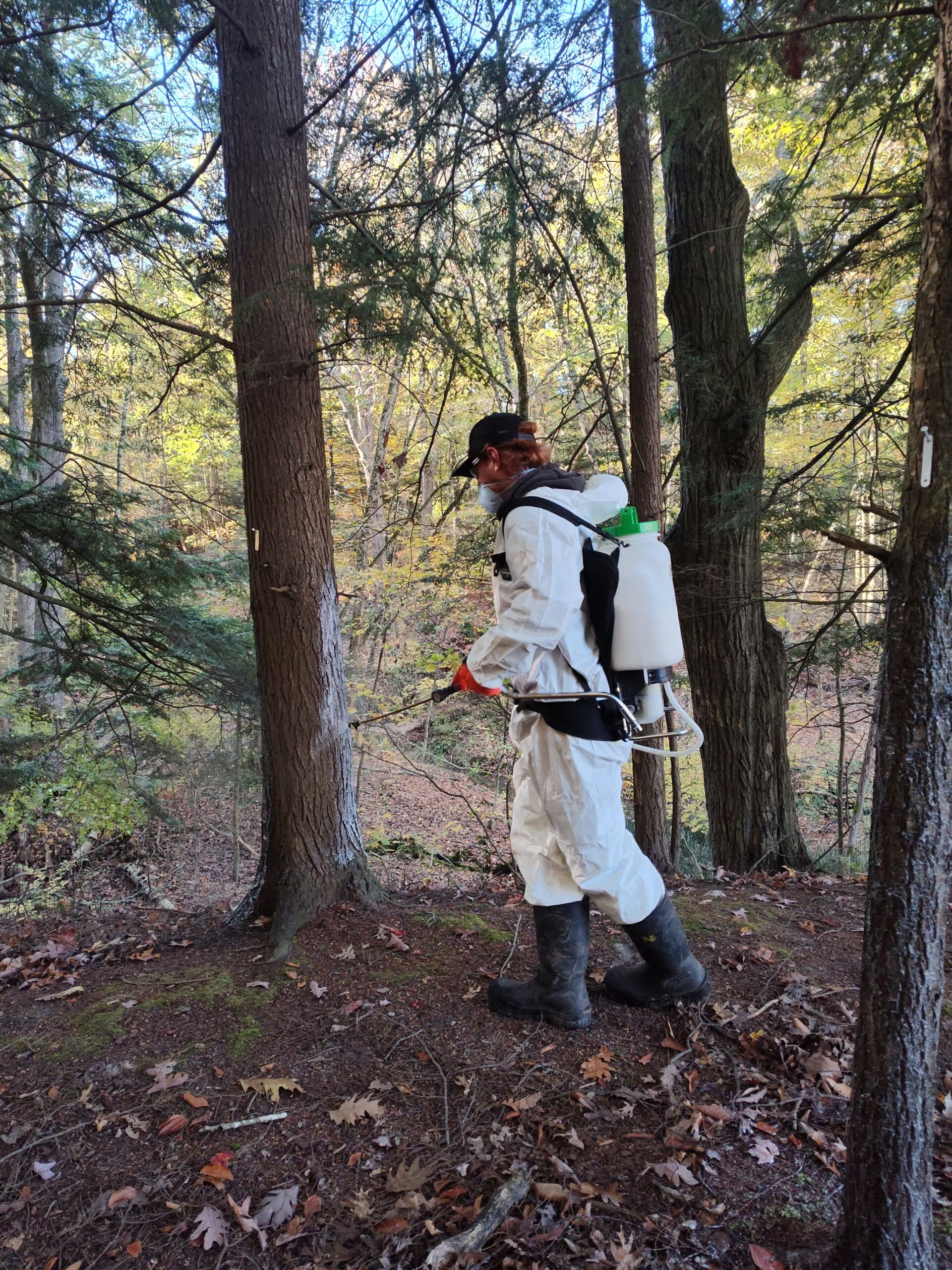
Aluminum nails are used because they are non-toxic to trees as well as rust resistant. Treating the hemlocks requires patience – only calm days with no rain the forecast will do when it comes to spraying the chemicals. PPE (personal protection equipment) is worn, and a special backpack sprayer is used, which has a pressure gauge and nozzle to ensure accuracy when applying the chemical. Staff using the chemical undergo extensive training on safe handling of chemicals. Joelle continued, “The treatment is applied directly to the lower trunk, coating the bark all the way around. The product itself is pale, and quite visible when first applied. Xytect is absorbed through the bark and moves upward through the tree’s vascular system, eventually reaching the foliage where the adelgids feed.
This takes time, with full effectiveness potentially taking several months. The advantage is that a single treatment can provide protection for several years, often estimated at five to seven years, although that depends on several factors. Since the application is made to the trunk, we’re able to target specifically selected trees without broadly spraying the canopy. Of course, the product still requires careful handling and environmental precautions, particularly in a sensitive area like this, and the applicators work within the label requirements and applicable site restrictions. As each tree is treated, its identification number is recorded, and the temporary flagging tape is removed.
The numbered tag remains in place, so we can revisit and monitor the trees in future years.” It’s important to note that the future is not written for the beloved hemlock tree. Great strides are being made every day in science, in the treatment of invasive species, in awareness, prevention, and care. It’s not too late. Challenges are being met head on and there are encouraging signs telling us the future is still rosy. And if you haven’t spent time with hemlocks, even though we believe they WILL persevere, maybe this is your sign to take a walk amongst those gentle giants!